

There's a particular kind of dress that doesn't try to impress you. It doesn't nip at the waist or flare at the hem or ask you to wear anything specific underneath. It just hangs there, clean and straight, from shoulder to somewhere above the knee. That's the shift dress — and despite its apparent simplicity, it has outlasted nearly every trend that tried to replace it over the past sixty years.
The short answer to "what is a shift dress" is structural: a shift dress is a straight-cut dress with no defined waist that falls from the shoulders to mid-thigh or knee, designed for ease of movement rather than body contouring. No darts at the bust. No cinching. No belt loops. The shape doesn't change whether you're sitting, standing, or somewhere in between.
But the shape only tells you half the story. Fabric, fit at the shoulders, and how you style it determine whether a shift reads as architectural office wear, an effortless summer errand dress, or something you'd wear to a cocktail party. This guide covers all of it — from the actual construction differences between a shift and a sheath, to which fabrics work for which seasons, to what makes a shift dress worth buying at any price point.
What Makes a Shift Dress Different from Other Silhouettes
Most dress silhouettes are designed around an idealized proportion — they assume a waist, assume a hip-to-shoulder ratio, assume you want to highlight certain things and minimize others. The shift doesn't assume any of that. It was, from its origins, a garment built around ease of movement and freedom from undergarment architecture.
When designers like Hubert de Givenchy and Mary Quant popularized the shift in the late 1950s and 1960s, they were reacting against the structural corsetry of postwar fashion. The New Look silhouette required significant underpinning. The shift required almost nothing. That was the point.
This is still what makes it function differently from other minimalist dresses. A wrap dress has waist definition. A bodycon has compression. A slip dress has a particular drape that reads as lingerie-adjacent. The shift is genuinely neutral — it doesn't perform a body type, it just covers one.
For anyone who's tried on a shift in a fitting room and thought "is this supposed to look like this?" — yes. The straight line is the feature, not a fit problem.
Shift Dress vs. Sheath Dress: The Actual Difference
This is the single most common point of confusion in dress shopping, and getting it wrong leads to buying the wrong silhouette entirely.
Know the difference
Shift Dress vs. Sheath Dress
Shift Dress
Straight or slightly A-line cut. Falls loosely from the shoulders. No waist definition, no darts at the waist. Skims the body without following its curves. Typically sleeveless with a high neckline. Prioritizes comfort and ease of movement. Best for relaxed, versatile dressing.
Sheath Dress
Form-fitting silhouette. Follows the body's curves through the bust, waist, and hips using darts and tucks. Defined waistline creates an hourglass shape. Usually includes a back slit for range of motion. More structured and formal. Best for polished, body-conscious looks.
The key difference between a shift dress and a sheath dress is fit: a shift hangs loosely with no waist definition, while a sheath follows the body's curves with darts and tucks at the waist. If you pick up a dress and it has visible waist shaping, seams that curve inward at the midsection, or a noticeably tighter fit through the hips — that's a sheath, not a shift.
The practical implication matters more than the terminology. A sheath dress requires precise body fit to look right. If it's slightly too tight, it pulls; slightly too loose, it sags. A shift is more forgiving. The fit only needs to be correct at two points — the shoulders and the hip circumference — and the rest takes care of itself.
For most women building a versatile wardrobe, a shift dress is the lower-maintenance option. It layers more easily, tolerates minor weight fluctuations without looking wrong, and works across a wider range of occasions without alteration. A sheath is the better choice when you want a more tailored, body-conscious silhouette for specific events or a polished office wardrobe.
How Fabric Changes What a Shift Dress Can Do
Because the silhouette is so understated, the fabric determines almost everything about how a shift dress reads.
A shift in ponte knit looks structured, almost architectural — appropriate for offices, reading as professional from about ten feet away. The same cut in cotton poplin reads more casual, a summer-errand dress. In silk crepe, it becomes occasion wear. In linen, it's warm-weather practical. In boucle, it borrows the vocabulary of classic Chanel suiting without the jacket.
The best fabric weight for a year-round shift dress is medium-weight — ponte knit, substantial crepe, or scuba — heavy enough to hold the silhouette without clinging. A shift that's too lightweight will cling and lose the clean line that makes the silhouette work. One that's too heavy can feel like wearing a box.
This is a significant advantage for buyers thinking about cost-per-wear. A well-constructed shift in a medium-weight fabric can be worn to more situations than almost any other dress style. It doesn't telegraph "this is a party dress" or "this is only for summer" the way most other cuts do.
A practical guide to fabric by season:
For summer: Cotton poplin, linen, or lightweight crepe. Choose opaque fabrics — a shift dress in a fabric that's too thin will cling through the seat and defeat the entire purpose of the silhouette. Lining matters here more than in most dress styles.
For fall and winter: Ponte knit, scuba, wool crepe, or boucle. These fabrics have enough body to maintain the clean line while layering with tights, boots, and outerwear. A heavier shift dress paired with a structured coat is one of the easiest cold-weather formulas that still looks intentional.
For year-round office wear: Medium-weight crepe or ponte in a solid neutral — black, navy, charcoal, camel — is the most reliable choice because it doesn't read as seasonal and works equally well under a blazer in January or on its own in July.
Product note: RIHOAS currently leans more toward A-line, slip, and shirt-dress cuts than literal shift dresses. The product cards below are therefore framed as shift-adjacent alternatives, not mislabeled as pure shifts.
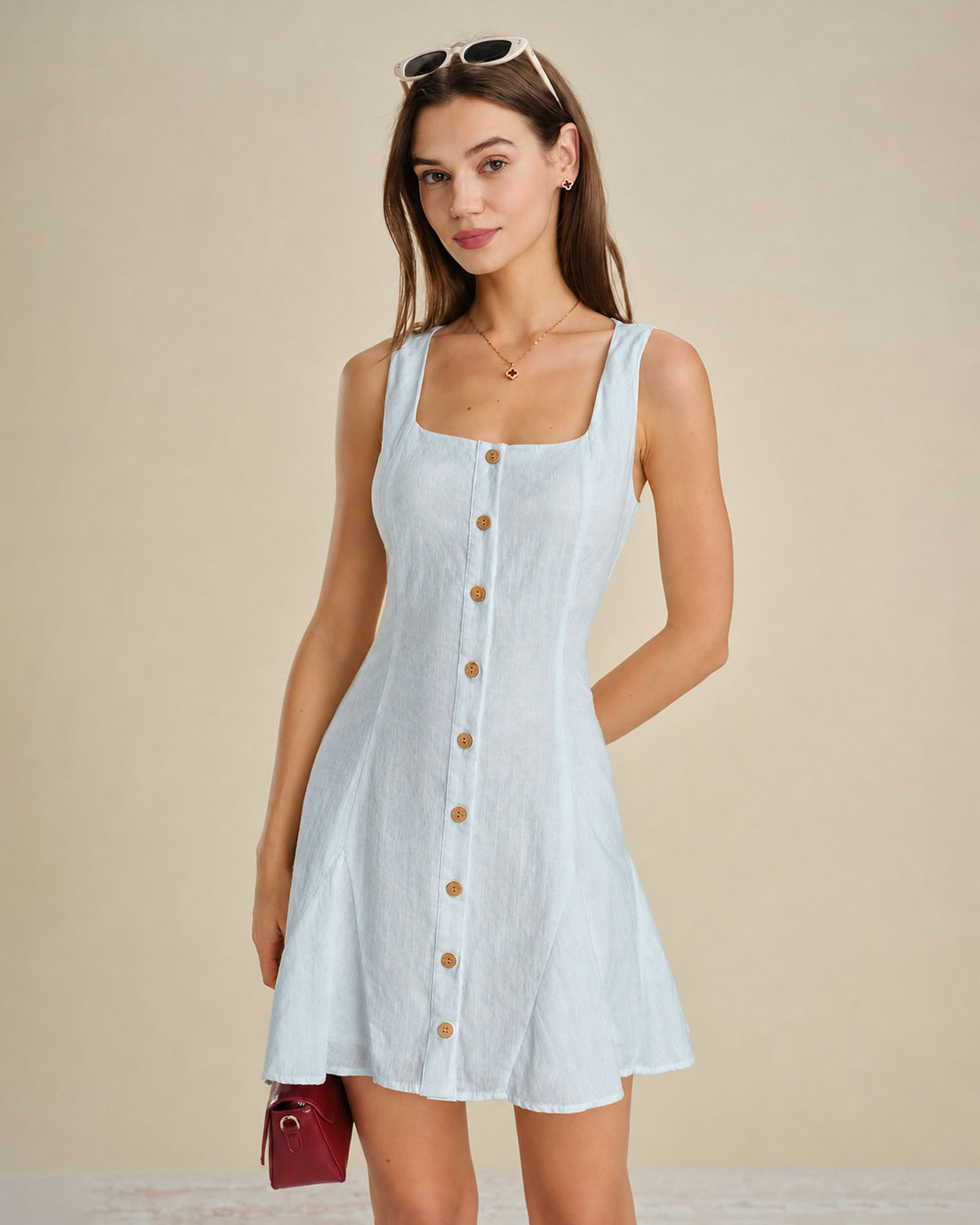
Closest clean-line option
A crisp cotton mini when a pure shift feels too boxy
The Blue Square Neck Textured Mini is not a strict shift; it is a clean A-line alternative with the same easy, unfussy styling logic. The 100% cotton shell, no-stretch structure, square neckline, solid color, and polyester lining make it useful for summer days when you want a simple dress that holds its shape without relying on cling.
How to Style a Shift Dress (Without Under-Styling It)
The shift dress is often sold — and bought — as a simple piece, which leads people to under-style it. That's a waste. The clean silhouette functions as a high-contrast background: accessories and layers land differently against a flat, straight surface than they do against a printed wrap or structured sheath.
For work: A solid-color shift dress in a structured fabric paired with a blazer and low heels is the most reliable work outfit formula because it reads professional without requiring precise body fit. Add a structured tote and minimal jewelry. If your office leans creative, swap the blazer for a longer cardigan or duster coat. For a deeper guide to wearing a shift dress to work, see our complete guide.
For evening and events: A shift in silk crepe or a textured fabric — jacquard, lace, or boucle — with statement earrings and heels. The trick is to let one element do the talking. A bold shoe with a simple shift. A striking necklace against a solid neckline. Over-accessorizing a shift dress usually diminishes rather than elevates it.
For casual weekends: The same shift with white sneakers and a crossbody bag becomes something almost sporty. A denim jacket thrown over it changes the register entirely. This is genuinely one of the most versatile silhouettes for off-duty dressing because the clean line accepts almost any layering direction.
For summer: A lightweight shift in a bold print — geometric, colorblock, retro floral — worn with almost nothing else. The print is the outfit. Flat sandals or espadrilles, a straw bag, done. A printed shift is one of the few vacation dresses that looks intentional without any styling effort.
Belt or no belt is a legitimate question. A thin belt at the natural waist creates waist definition, which some people prefer — but it also changes the dress into a different silhouette, essentially a belted dress rather than a shift. Both are valid. The choice depends on whether you want the architectural flat line or a more shaped look.
Layering that works reliably: A shift with a longer duster coat or cardigan creates length contrast between the coat hem and the dress hem — a proportion that reads intentional rather than accidental. A structured blazer adds formality. A leather jacket adds edge. A chunky knit cardigan softens the whole thing for weekend wear.
Office alternative
A navy shirt dress for the workwear role a shift usually plays
The Navy Pocket Short Sleeve Midi is a shirt dress, not a pure shift, so it gives more waist shape than the classic silhouette. It still fits the workwear need: no-stretch cotton-linen fabric, a solid navy color, practical pockets, a midi length, and a polyester lining for opacity. Use it when you want the polish of a shift but prefer a collared neckline and a softer A-line skirt.

Which Body Types Work Best in a Shift Dress
There's a persistent myth that shift dresses only work on straight figures and fail on anyone with curves. This is mostly wrong, but it requires nuance rather than a blanket reassurance.
The issue isn't the straight silhouette itself — it's the fit through the shoulder and hip. A shift dress works best when the shoulder seam sits exactly at the edge of the shoulder bone. If the shoulders are right, the rest of the dress will hang correctly regardless of body shape. The key measurement for a shift is not the waist — it's shoulder width and hip circumference.
Straight and rectangular body types get the cleanest line in a shift because the silhouette mirrors the body's natural proportions. This is the easiest body type to shop for in this cut.
Apple body types benefit from the shift's defining feature: the absence of waist definition. A shift skims past the midsection without drawing a horizontal line across it, which makes it one of the most flattering silhouettes for women who carry weight through their torso.
For women with a larger bust, the traditional shift (which has no bust shaping) can sometimes create a tent effect where the fabric drapes off the fullest point of the chest and hangs away from the body below. A shift dress with a slight A-line flare below the hip works better than a purely straight cut for larger busts because it provides room through the hip and thigh without relying on the chest to hold the fabric in place.
Pear and hourglass body types can look excellent in a shift — the straight line through the torso balances broader hips rather than emphasizing them. The risk is a shift that's too narrow through the hips, which will pull and lose the clean vertical line. If you're between sizes, size up and have the shoulders taken in rather than sizing down and fighting the hip fit.
If the shift dress you're trying on pulls across the hips, bunches at the bust, or hangs like a sack through the middle — the dress isn't fitting properly. That's a size or cut problem, not a body type problem. Try a different size, a different brand, or a slightly A-line version before deciding the silhouette doesn't work for you.
What to Look for When Buying a Shift Dress
Shift dresses exist at every price tier from fast fashion to designer. The silhouette is simple enough that a less expensive version can look quite good. But there are specific places where construction quality becomes visible — and where cutting corners ruins the whole point of the silhouette.
Shoulder seams should sit exactly at the edge of the shoulder. This is the single most important fit point on a shift dress and the first thing to check in a fitting room.
Side seams should lie flat without pulling. Any puckering along the side seam means the dress is either too tight through the hip or cut on a grain that's fighting the fabric's natural drape.
The hem should hang evenly all the way around. This is harder to achieve than it sounds and is often where cheaper construction shows. An uneven hem on a shift dress is immediately visible because there's nothing else to distract from it.
Lining matters more in a shift than in most other dress styles because the fabric has nowhere to hide. An unlined shift in a medium-weight fabric can work if the fabric has enough body. An unlined shift in anything lightweight tends to cling and distort through the seat in a way that undercuts the whole point of the silhouette.
Dart suppression: Even in a nominally "no-dart" shift, some have subtle darts at the chest for fit. These should be pressed flat and smooth. Visible, unpressed darts on a shift dress look like a construction error because the silhouette is supposed to be clean.
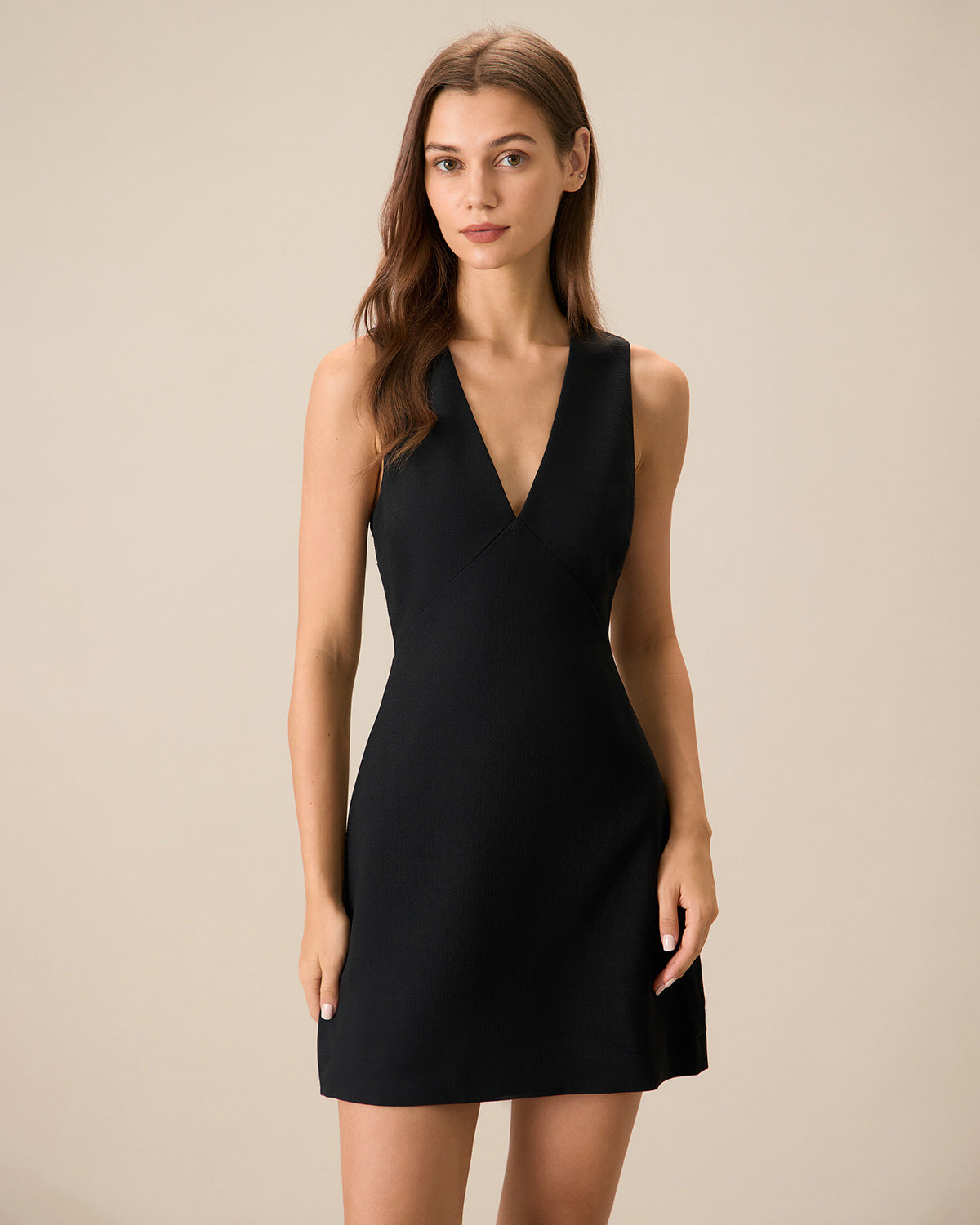
Minimal base pick
A black sleeveless dress when you want the same styling simplicity
The Women's Black V-Neck Sleeveless Mini is another shift-adjacent option rather than a literal shift: it has a high waist and A-line shape. The reason it belongs here is the styling role. The linen-viscose fabric, full lining, no-stretch construction, and clean black finish make it an easy base for sandals, a blazer, a denim jacket, or evening jewelry.
Frequently Asked Questions
Can you wear a shift dress to work?
Yes — a shift dress is one of the most practical work dress silhouettes because it reads as professional without requiring precise body fit. Choose a medium-weight fabric like ponte knit or crepe in a solid neutral color, and pair it with a blazer for meetings. The straight silhouette moves easily between a desk chair, a conference room, and a lunch meeting without needing adjustment.
What shoes look best with a shift dress?
The best shoe depends on the occasion. For work, low pumps or loafers keep the look polished. For casual wear, white sneakers or flat sandals shift the register entirely. For evening events, a pointed-toe heel or strappy sandal adds enough formality without competing with the dress. Block heels under three inches are the most comfortable option if you'll be standing for extended periods.
Are shift dresses flattering on curvy figures?
A shift dress can be very flattering on curvy figures when the fit is right at the shoulders and hips. The straight silhouette skims past the waist without creating a horizontal line, which is actually an advantage for women who carry weight through the midsection. For larger busts, look for a shift with a slight A-line flare below the hip to prevent the fabric from draping off the chest and hiding the body below.
Can you wear a shift dress in winter?
Absolutely. A shift dress in a heavier fabric — ponte knit, wool crepe, or boucle — works well with opaque tights, ankle boots or knee-high boots, and a structured coat or blazer. The clean silhouette layers easily because there's no waist definition or gathered fabric to create bulk under outerwear. A turtleneck layered underneath a sleeveless shift is another reliable cold-weather formula.
What is the difference between a shift dress and an A-line dress?
A shift dress falls straight from the shoulders with no waist definition and minimal flare at the hem. An A-line dress is fitted through the bodice and waist, then flares out from the waist or hip in a triangular shape resembling the letter "A." The key distinction is waist definition: an A-line has it, a shift deliberately avoids it. Some shift dresses have a very slight A-line flare, but the silhouette remains predominantly straight.
How long should a shift dress be?
The classic shift dress hits at mid-thigh to just above the knee, which is the most versatile length for the silhouette. Knee-length works well for office settings and more conservative events. Midi-length shifts exist but change the proportion significantly — they can read more like a column dress than a traditional shift. If you're petite, a shift that ends two inches above the knee usually creates the most balanced proportion.
Final fit check
Choose the Shape That Does the Job
A true shift should hang cleanly from the shoulders without waist definition. If you prefer a little more shape, choose a shift-adjacent A-line, shirt dress, or clean sleeveless style instead.


